The two types of AI workflow automation we offer
There are two major use cases for AI workflow integration. 1. Powering up the software engineering process used to build custom software for you. 2. Automating your business processes with agentic AI
Agentic AI workflow for software development automation
We turn scattered use of AI coding tools into connected delivery workflows. The exact setup depends on the team's process, but a typical AI software engineering workflow can look like this:
Requirements understandingAn AI agent analyzes the ticket, identifies missing information, clarifies requirements, and helps define acceptance criteria before implementation begins.
Implementation planningThe next step turns approved requirements into a technical plan. The agent outlines the implementation approach, breaks the work into tasks, and accounts for the existing architecture.
DevelopmentAI supports implementation using the approved plan, project context, and engineering standards. The goal is to produce code that is ready for testing and review.
Testing and verificationThe workflow runs relevant checks against the implementation, identifies issues, and verifies whether the feature behaves as expected before it moves forward.
Code reviewAn AI review step examines the proposed changes for potential defects, regressions, and deviations from the intended implementation or engineering standards.
Pull request preparationAI engineering workflow prepares a review-ready pull request with the relevant description, test results, and implementation context for the engineering team.
Human review at defined checkpointsYour team remains responsible for key decisions. Human approval can be introduced at each step of the workflow, depending on the risk and importance of the change.
Key benefits of AI workflow software delivery
Faster delivery
Ship features significantly faster with AI agents
Lower engineering costs
Automate repetitive work and increase team productivity
Maintained quality
Automated checks and human review keep quality high
Fits your team
Designed around your existing repositories, tools and processes
The workflow includes:
- Expected behavior defined from tickets, acceptance criteria, and code changes
- AI-generated test scenarios based on the live application
- Human review before test code is generated
- Playwright test generation from the approved plan
- Failure triage to distinguish outdated tests from real product bugs
- Deterministic checks for repeatable validation and execution metrics
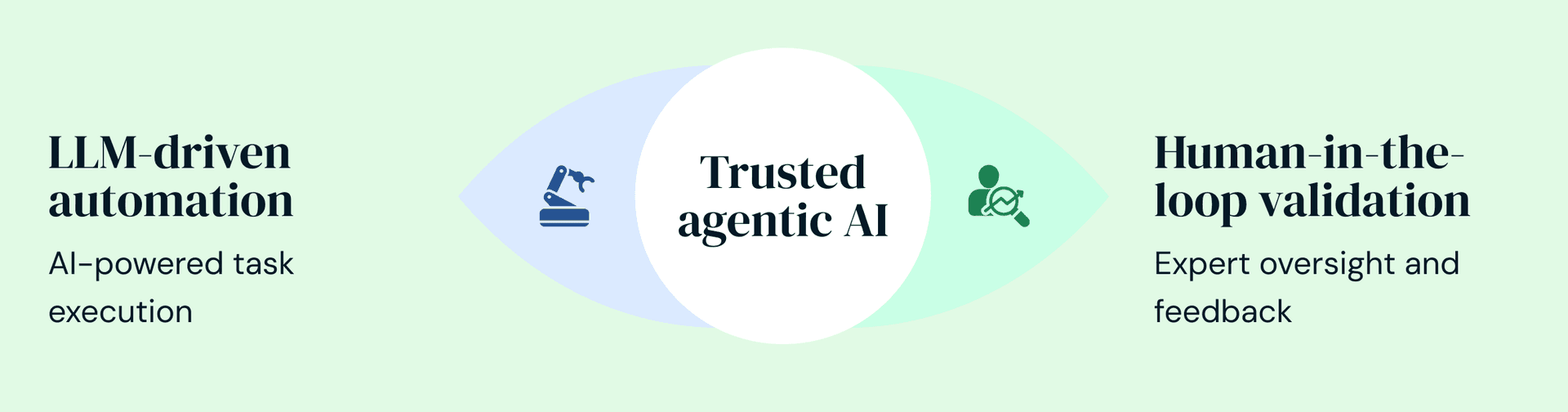
The result is a controlled QA workflow where AI speeds up test creation while human review and validation rules help preserve test quality and expose real defects instead of hiding them.
IT infrastructure and standards
AI software development workflows should fit into the way your team already builds software. We connect the workflow to your existing development environment and make sure the agents work with the same project context and engineering rules as your developers.
Repositories
Connect agents to the codebases they need to understand and modify, with access limited to the projects and branches relevant to the workflow.
Development environment
Integrate the workflow with the environments your team already uses for software implementation, testing, and validation.
Tools and integrations
Connect AI-assisted work with your existing engineering tools so information can move between tickets, repositories, CI/CD systems, and other parts of the delivery process.
Security and compliance
Apply the access controls and security requirements already used by your engineering team, including restrictions around code, credentials, and sensitive project data.
Coding standards
Give agents clear engineering instructions so generated changes follow the conventions, architecture patterns, and quality expectations of the existing codebase.
Project context and documentation
Maintain the technical context agents need to work consistently over time, including architecture knowledge, project instructions, and relevant documentation.
Your processes
Adapt the workflow to the way your team already plans, reviews, approves, and releases software instead of forcing a separate AI-specific process.
Business workflow automation
Automate recurring business processes where AI can reduce manual work and help teams handle information faster.
Document and data workflows
Automate the processing of contracts, forms, reports, applications, and other documents. AI can extract relevant information, classify content, compare documents, and route results to the right system or person.
Customer support automation
Build workflows that help classify requests, find relevant information, prepare responses, and escalate cases when human input is needed. The workflow can connect directly with your existing support tools and knowledge base.
Compliance and review workflows
Use AI to review submissions, documents, or internal records against predefined requirements. The system can flag issues, explain findings, and keep evidence linked to each result for further human review.
Research and reporting workflows
Automate information gathering, synthesis, and report preparation across internal or approved external sources. AI can turn large volumes of information into structured findings that are easier for teams to review and use.
Back-office workflow automation
Reduce repetitive work across internal operations by automating tasks such as data entry, document routing, request processing, and information handoffs between systems.
Human-in-the-loop workflows
Automate processes that still require approval or expert judgment at critical stages. The workflow can pause for review, record the decision, and continue automatically once the required input is provided.
What sets us apart
Here's what makes Apiko agentic AI development services stand out
Clients trust usWith 60+ verified Clutch reviews and a 4.9/5 rating, we have a strong track record of reliable delivery and long-term client relationships.
Strong software engineering foundationAI workflows still depend on solid architecture, integrations, testing, security, and infrastructure. Our product engineering background helps us build automation that fits into the wider system.
Experience with AI agentic systemsWe work with multi-step AI workflows that use specialized agents, shared context, tool access, and human checkpoints. This allows us to automate more complex processes while keeping behavior visible and controllable.
Support beyond implementationAI workflows need to transform as models, tools, and business requirements change. We continue supporting the system after launch, improve existing workflows, and introduce new automation where it proves useful.
Where AI workflow automation brings impact
AI workflow automation works best where teams spend too much time moving information between systems, reviewing repetitive inputs, or coordinating routine decisions.
Construction
Reduce manual coordination between field and office teams. AI workflows can help process site reports, review project documents, summarize updates, and route issues to the right person faster.
Manufacturing
Streamline operational workflows around production data, maintenance records, quality checks, and internal reporting. AI can help teams surface exceptions sooner and spend less time reviewing repetitive information manually.
E-commerce
Automate product content, customer support, order-related workflows, and internal reporting. AI workflows can also connect information across commerce, logistics, and support systems to reduce repetitive handoffs.
ESG & sustainability
Make reporting workflows easier to manage across large volumes of documents and structured data. AI can support evidence review, data validation, reporting, and assessment against defined sustainability criteria.
Healthcare
Support administrative and document-heavy workflows while keeping human review where it matters. AI can help with information extraction, internal research, reporting, and other processes around care delivery.
Real estate
Automate routine work around listings, documents, enquiries, and property operations. AI workflows can help teams process incoming information faster and keep data synchronized across internal systems.
Fintech
Speed up workflows that involve document review, internal research, compliance checks, or customer requests. AI can help structure information and prepare findings while keeping critical decisions under human control.
FAQ
No. Effective AI workflow automation often combines AI agents with standard automation. AI is best used for tasks that require reasoning, or flexible decision-making, while predictable steps can stay deterministic.
First, we analyze the existing process and identify where AI can create measurable value. In business operations, that may mean document review or research. In AI-assisted software development, it can include planning, code review, QA, or project context management.
Yes. We design AI workflow automation around the systems your team already uses. This can include business platforms, internal data sources, repositories, CI/CD tools, and engineering environments used for AI-powered software development.
We define the relevant KPIs together with your team before implementation. Depending on the workflow, we may measure time saved, review effort, rework, quality, completion rates, or operating costs. For AI-assisted software development, the KPIs can also reflect how AI affects delivery speed and engineering effort.